i-vote Sweden
A self-initiated UX study of online voting in Swedish elections: research, interviews, prototypes and usability testing.
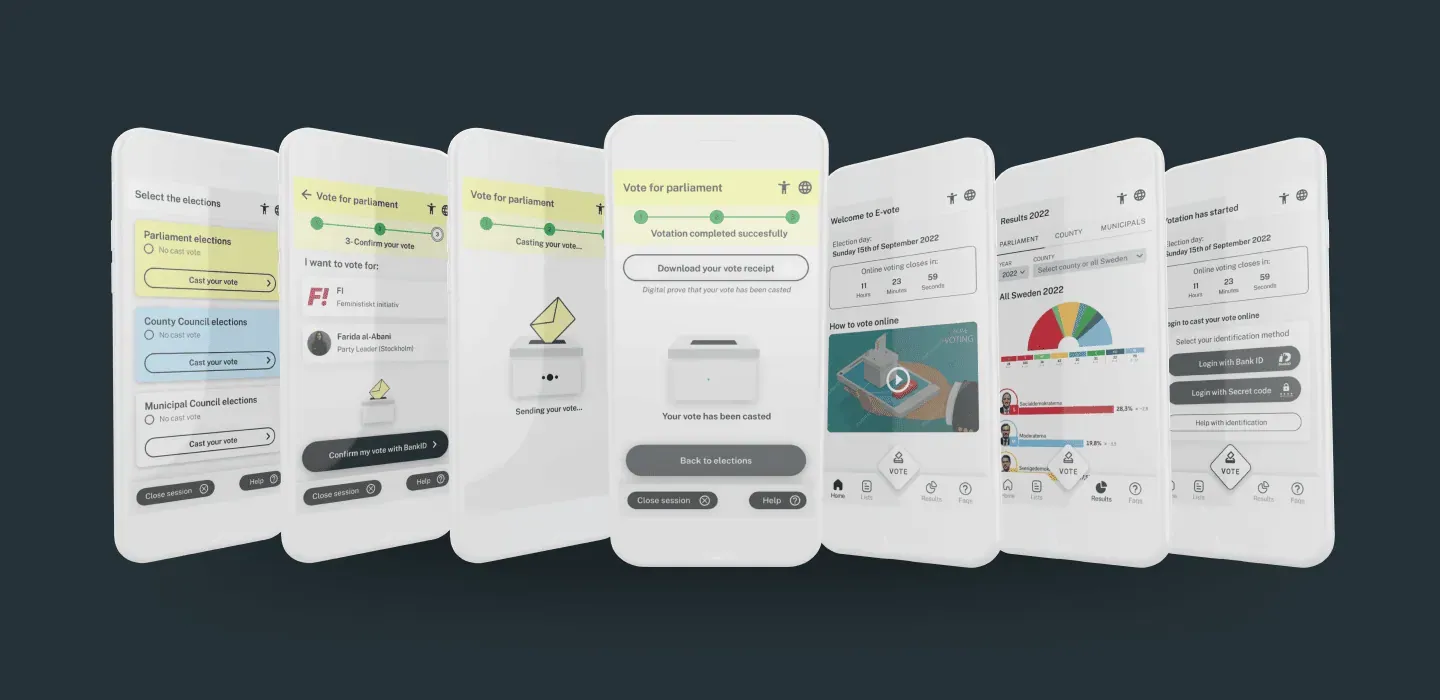
Case study of an app to vote online in the Swedish elections as a complement to traditional voting. The main challenges and priorities were security, usability and accessibility.
Vote online app
UX/UI Design case study
Built with Figma
01
Empathize
Inspiration board, research, personas, target
Research
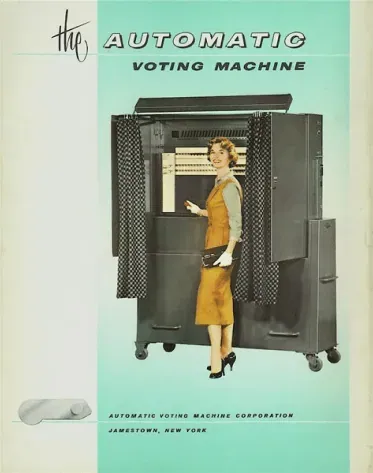
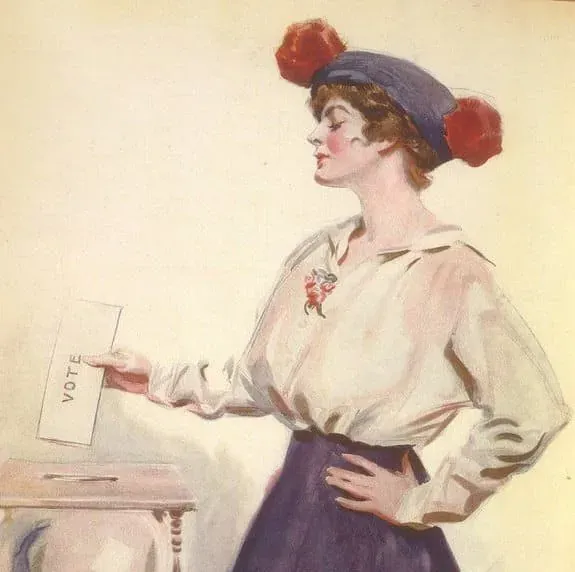
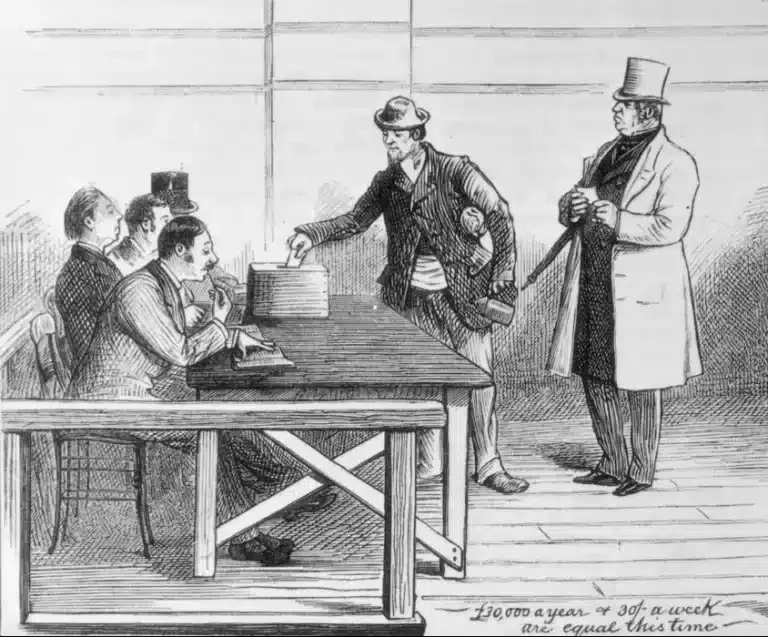
During the research process I discovered that the thought of electronic voting has always been there. Since the Australian ballot method was implemented in almost every democracy, the idea of voting with a machine has been tested in many countries, but there are still a lot of doubts about internet voting.
Countries like Switzerland or Estonia have used a well implemented system for some years now. An argument for internet voting is: “If I can send my tax return online and it’s secure enough why not voting online?”. It’s true that internet voting can be vulnerable, the fear of a security issue is understandable. But today we have the tools to guaranty the security, to implement it it’s a matter of political will.
In the Swedish case, it wouldn’t be difficult to implement because the population is very digitized. According to Skatteverket in 2020 6,5 of 8 million citizens sent their tax return online. Also BankID can guarantee a safe authentication method that is well extended in all age segments of the population. According to their statistiks more than 96% users between 21 and 70 years old have BankID and 66% in the 71 and 80 age segment.
Security
Security is the main concern when voting online. Beside the technical security aspects, the user experience must give the perception of security to the user.
Accessibility
Vote is a right and it has to be guaranteed to all citizens. The service must provide provide accessibility tools so that all the citizens can vote online.
Usability
The process of casting the vote must be simple and easy to understand for a very wide variety of users, in fact, all the population is a potential user.
Potential benefits of internet voting
Online voting would be, at first, a complement to the traditional method. Now a days is tecnically possible, it’s only a matter of political will to implement it. These are the main benefeits of online voting.
- Makes voting more accessible for citizens with mobility issues
- It simplifies the process of voting for citizens living abroad
- More guaranties and security than voting by post
- Fast and secure counting
- It can increase participation
- In the long term it can be more efficient and ecological
Target
The target is very wide because the app is aimed at the entire population old enough to vote. Although the different target groups will end up using the service for different reasons.
Younger audiences might be more open to vote through an app and it might increase their participation and engagement. At first glance it might be difficult to get to the elderly audience, but it can be very useful for people with mobility issues.
Also in this pandemic times that is mandatory to avoid crowds, this service would reduce risks without affecting the participation in the party of democracy.
Personas
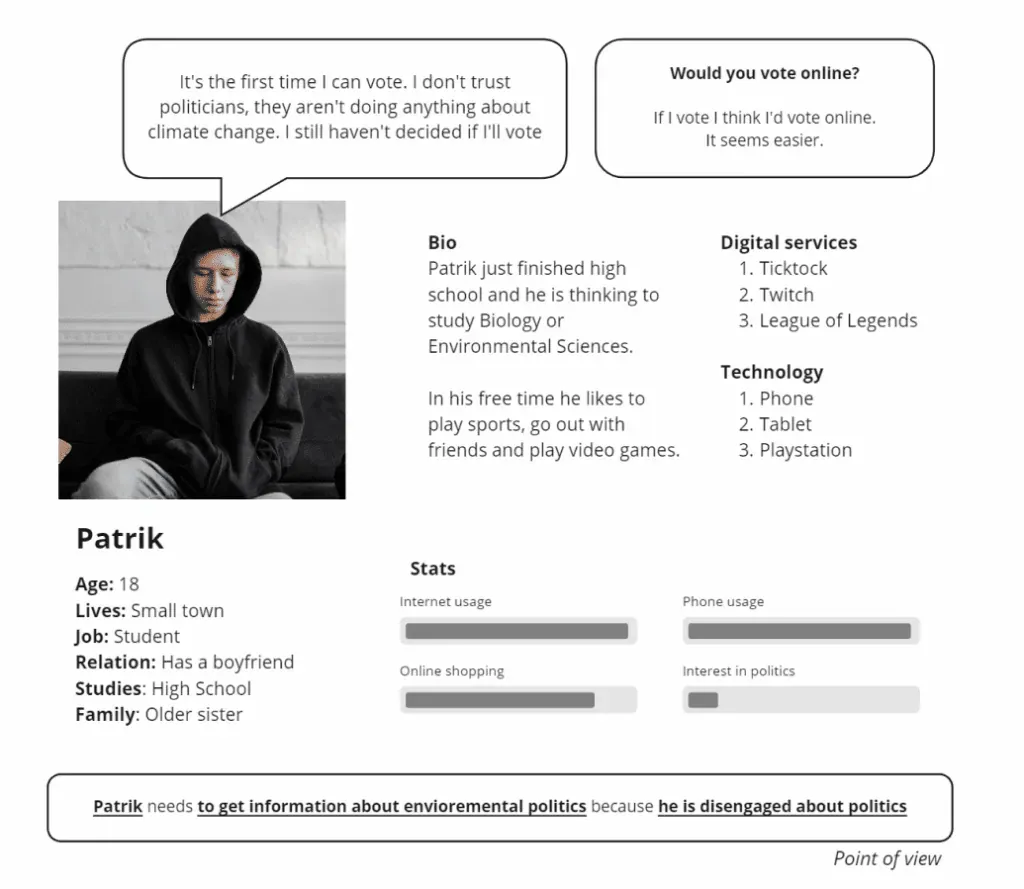
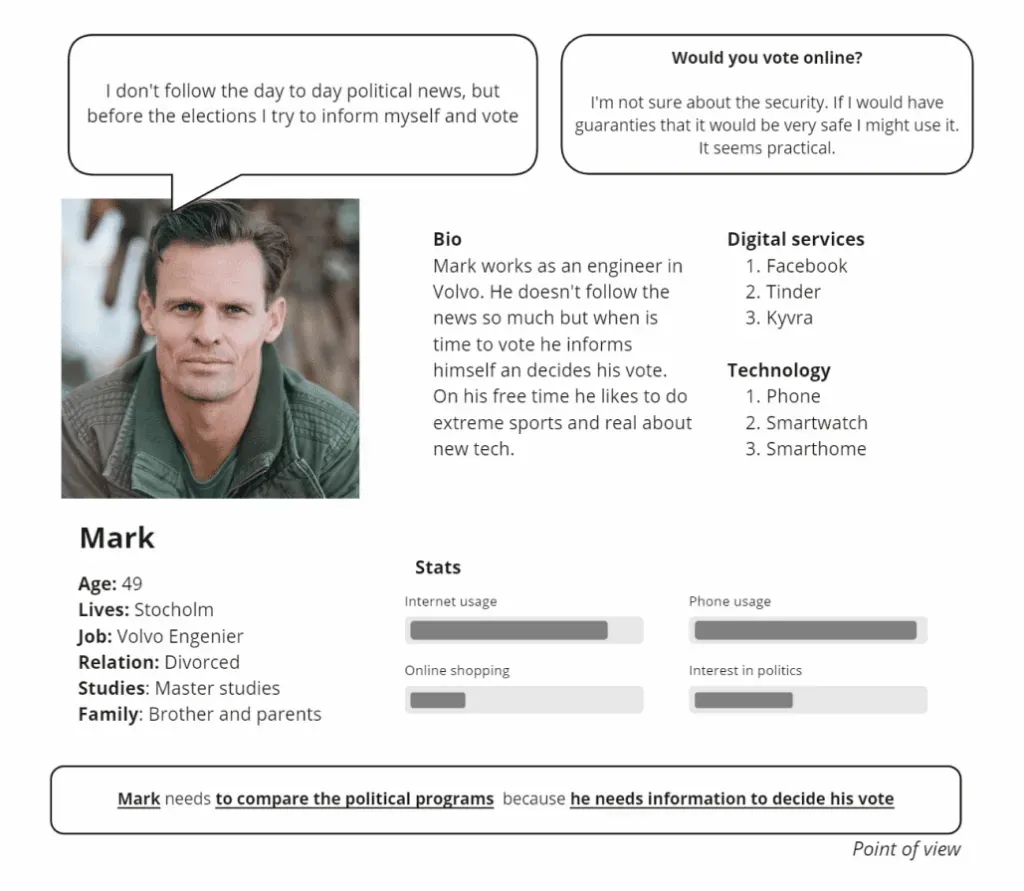
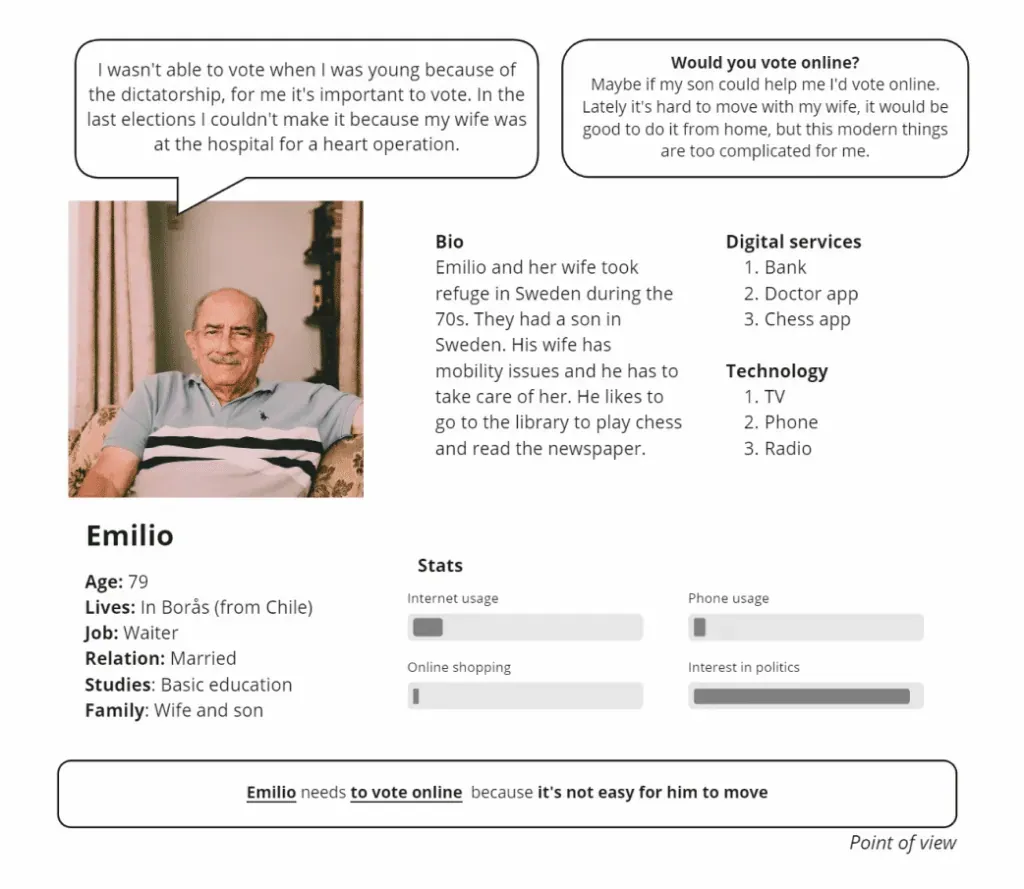
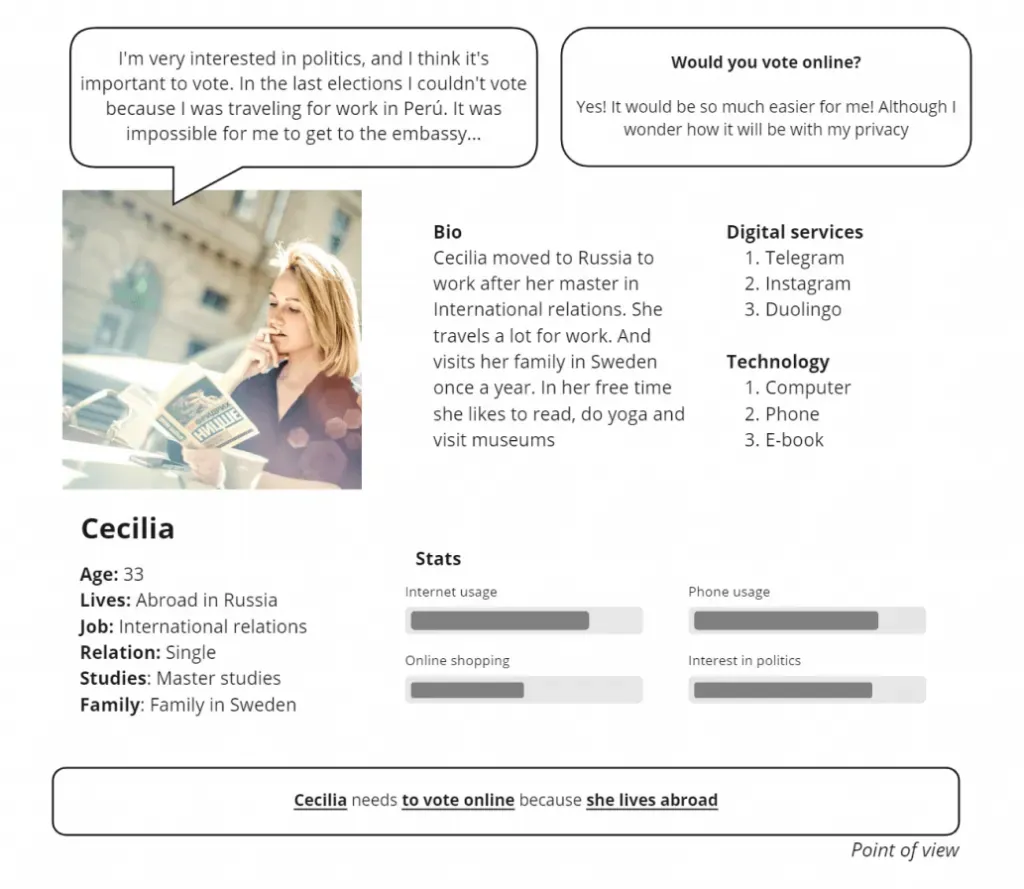
02
Define
Interviews, questionare, conclusions
Qualitative interviews
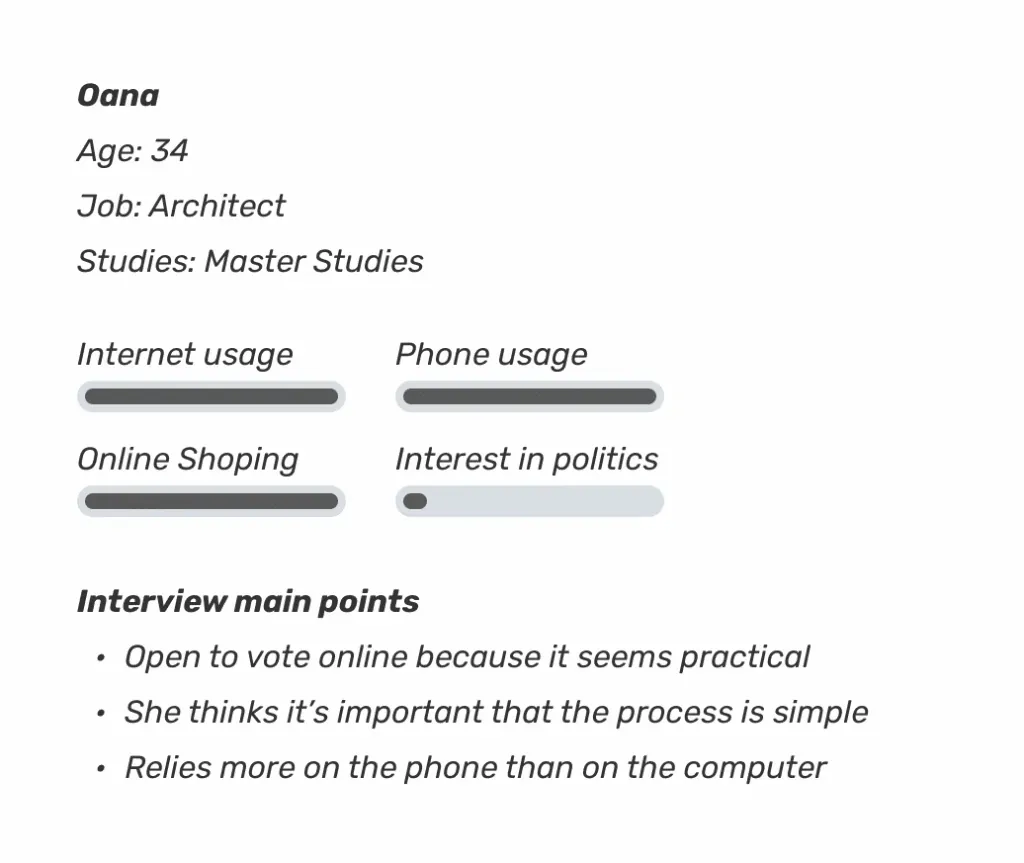
Oana: Reading news, social media, photos, shopping. Buys more with the phone than the computer.
Pere: Whatsapp, read news, twitter, podcasts
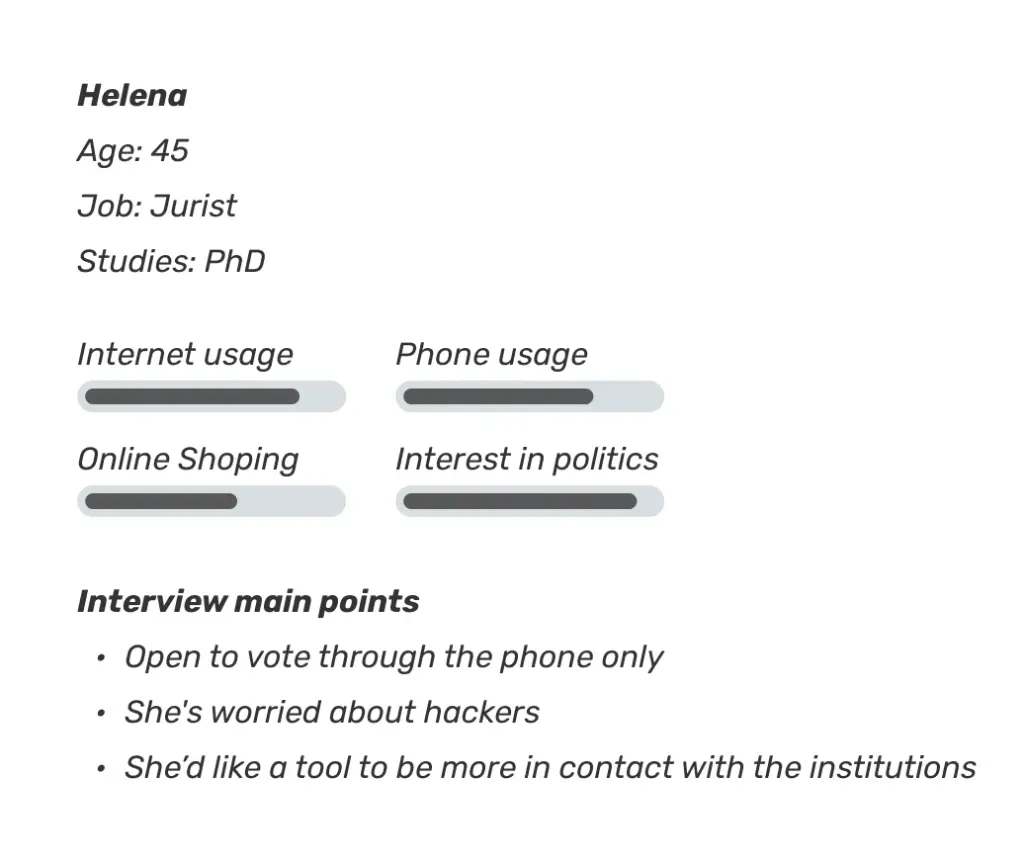
Helena: Whatsapp, read news, music.
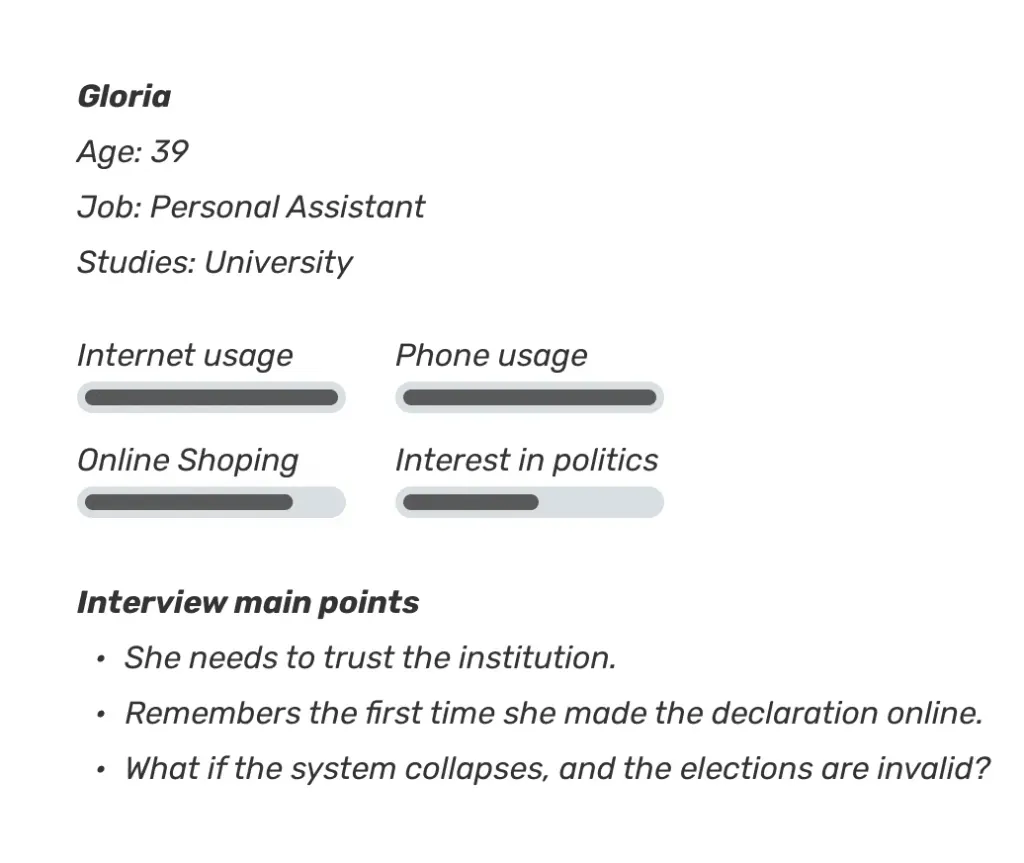
Gloria: Contact friends, social media, google search
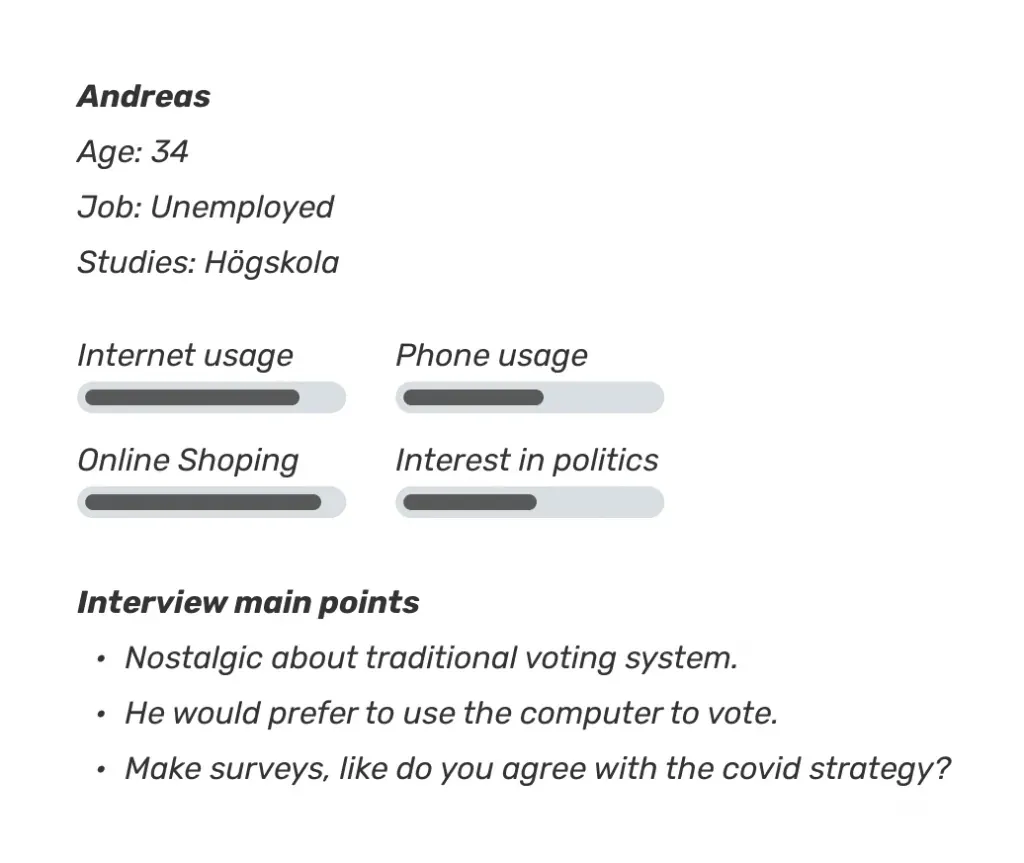
Andreas: Contact friends and family, listen to music or podcasts, search when I need.
Oana: At least every month
Pere: Not so often and usually from the computer, last month the keyboard of my computer broke and I had to buy a replacement from the phone, sometimes I’ve bought plane tickets from my phone also, but if I can I use the computer.
Helena: Sometimes clothes for my kids with my phone. and to buy all my flights I use the phone.
Gloria: Yes, farmaceutical products, and now with the pandemic even more. Only from muy phone.
Andreas: Yes at least once a month, both from my computer and phone, depending on what store.
**Oana:Online from the phone through the skateverket app. I’ve never have done it with paper. **
Pere: The last time, I did it on paper
Helena: I’ve only done it online.
Gloria: Yes from my phone, the first time they opened I think it was 6 or 8 years ago, I still remember when I had to do it with paper, it was so had…
Andreas: Yes, from my computer.
**Oana:**I usually vote, it would be very convenient to vote online
Pere: Yes, I usually vote, but the last elections I couldn’t because I was traveling. It would be useful like to do it online, because last time I couldn’t vote.
Helena: Yes, I usually vote, It would be useful like to do it online, why not?
Gloria: Yes I usually vote. I’m from Mexico and there I wouldn’t trust the institutions, but in Sweden I’d feel much safer. Maybe the first time it would be weird, like the first time i did the declaration online.
Andreas: Yes I usually vote. I’d be a bit skeptical first, I understand that it can be practical. But I like the feeling of voting, going there, seeing the people, it’s some way to connect.
**Oana:Phone or computer it doesn’t matter, or even some machine at the voting stations. **
Pere: Through the computer
Helena: Maybe with the phone.
Gloria: The phone, I don’t have a computer right now
Andreas: Computer, it feels nicer.
**Oana:**Not sure
Pere: I don’t know, I’d also like to vote from the computer
Helena: Meanwhile there’s the classical system, just with the phone it could be a start.
Gloria: Yes
Andreas: I wouldn’t mind, but if I could do it from the computer better
**Oana:Security and simple process **
Pere: Security, and confidentiality and control over the system
Helena: I’d be worried about the hackers.
Gloria: What if the system collapses? And then they need to repeat elections? For a hacker attack or just an informatic mistake.
Andreas: If it’s really trustable, if it doesn’t work it could be a really big problem.
**Oana:**Read and compare different parties programs, but mainly to be quick.
Pere: There could be tools for the citizens to exercise of political rights or create popular initiatives.
Helena: Agenda of the campaign, results, follow the counting. And maybe participate more than just every 4 years by doing referendums, or make tools for the population to be more in contact with the institutions.
Gloria: Statistics, electoral census, and more participation in general.
Andreas: To get people opinions or ask questions to the populations, like do you agree with the covid strategy.
Interviews overview
Quantitative interviews
30/45 age segment show more interest in online voting, and is the segment that would more likely vote through their phone.
Users that buy online very often can also show skepticism about online voting.
Users that do their tax return through the computer would also vote with the phone. There’s no clear relation.
Users that are less interested in politics are more likely to vote from the phone, this graphic shows that 83% of the users would use their phone:
Users that are more interested in politics would use their phone less, and expressed more concerns about security:
Users that always vote are more skeptical about online voting.
Users that vote by post show more interest in online voting.
The age segment that is more skeptical about online voting is 45/60 years old with 58% Yes 25% Not sure and 16% No.
The 30/45 segment is the one that is more open with 93% yes and 7% not sure. Followed by the 18/30 that is 78% Yes and 22% not sure.
Users would clearly prefer the phone, but the 37% of interest on voting through the desktop is to be considered.
Again the age segment that was more open to vote from the phone is the 30/45 by 87% for the phone and 13% desktop. Surprisingly the 18/35 segment would prefer the desktop by 56% and 44% the phone.
Most interesting answers for YES:
- Nothing I thought of before but now when you ask the question it would make it easier.
- I think it would make it more accessible.
- Much easier and faster.
- For those who can’t go in person … Illness, age …
- Because I live abroad and voting by post is not always reliable, it gets delayed, and too many other problems.
Most interesting answers for NO:
- It adds complexity to maintaining the integrity and transparency of elections.
- I like to meet People
Most interesting answers for MAYBE:
- Doubtful about keeping the voting anonymity.
- Online systems are easier to hack.
- It will be easier and more practical but on the other hand who controls and monitor your votes?
- The election day is ritual that remind you of your rights and obligation in a democracy, I am not so sure it would be positive addition to undermine and simplify it this way. Maybe more of an addition for people that can not attend that day, like post voting.
This was an open question and the word SECURITY appears in 95% of the answers:
Most interesting answers:
- Safety and reliability. I would suspect a higher risk of electoral fraud in general.
- Transparency and open source software that cannot be hacked or manipulated.
- Easy access, with something like bankID
- Two things: security ( avoid fake ballots or fraud ) and a written confirmation my ballot had been counted.
- Security and anonymity, easiness, and then it needs to be clear.
- That it feels safe.
- Trust and security.
- The tracking of my vote and the reliability of the system, and of course to make it easy!
Most interesting answers:
- See pending bills, big political topics being discussed and what the parties think about them.
- Clear instructions on how to vote, access to stats ( census info of the country where I vote ) and eleccions results.
- Get information about the different parties, maybe a test that I can take before I vote so I know where I stand in different questions that makes it easier to vote. Maybe invite friends button to spread the word that you now can vote online (to help spread the word and to get more people to vote).
- Identity approval (like a BankId in Sweden)
- Security functionalities, such as a vote confirmation token, for example.
- Real time results of the elections
Interview conclusions
Beside the technical aspects of how the vote is encrypted, from the UX perspective security will be more perceived than understood. The user won’t understand the technical aspects but must feel safe.
Security must be explained in the onboarding process and the interaction and the UI must make the user feel safe and have a perception of security.
Populations that trust more in their institutions will feel more secure voting online. Like Gloria said in her interview, she would vote online in Sweden but not in Mexico.
The app must aim for much more than just the voting period/day. There must be functions BEFORE and AFTER the elections. Like a Survey to help deciding the vote, easy access to political programs and follow the results after the election.
Some of the features that the users might find interesting might not be implemented due to legal and constitutional considerations. The app must have in consideration the user needs but also the legal needs in order to have a clean electoral process.
It’s surprising that this age segment is more open to vote online than the younger segment of 18/30. It might be because the younger segment are more conscious about privacy issues and the older segment of 45/60 are more concerned about security.
Online voting is a completely different experience, nostalgia is understandable. The implementation of online voting will be slow because this habits can be very difficult to replace. Although in the beginning online voting will be more a complement than a replacement to the traditional method.
For security, to evoid coercion and even for usability, the users can vote as many times as they want, only last vote counts. The vote is sent and stored anonymously, but the users can get a confirmation code that confirms that their vote has been sent correctly. After the elections the users can also require a confirmation code that confirms that their vote has been casted correctly.
03
Ideate
Affinity mapping, sketches, crazy eight, user flows
Affinity Mapping
Secure & usable voting system
Check if I’m registered to vote online and if my device is compatible
Quiz to decide the vote
Privacy, the app can’t collect any user data
Read and compare political programs
Fingertip identification & Facial recognition
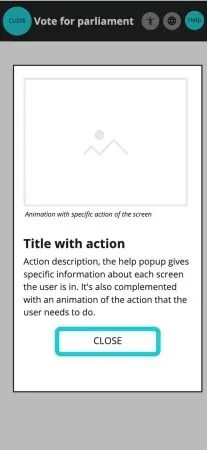
Clear instructions and help guidelines
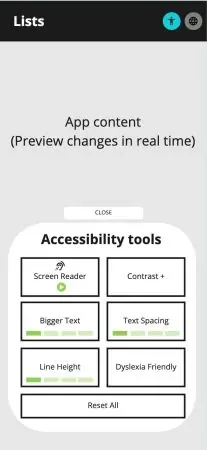
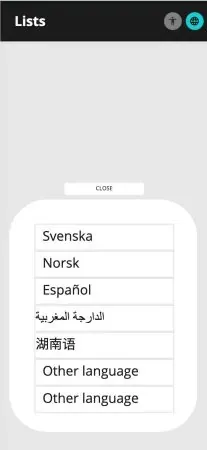
Accessibility tools and different languages
User flows
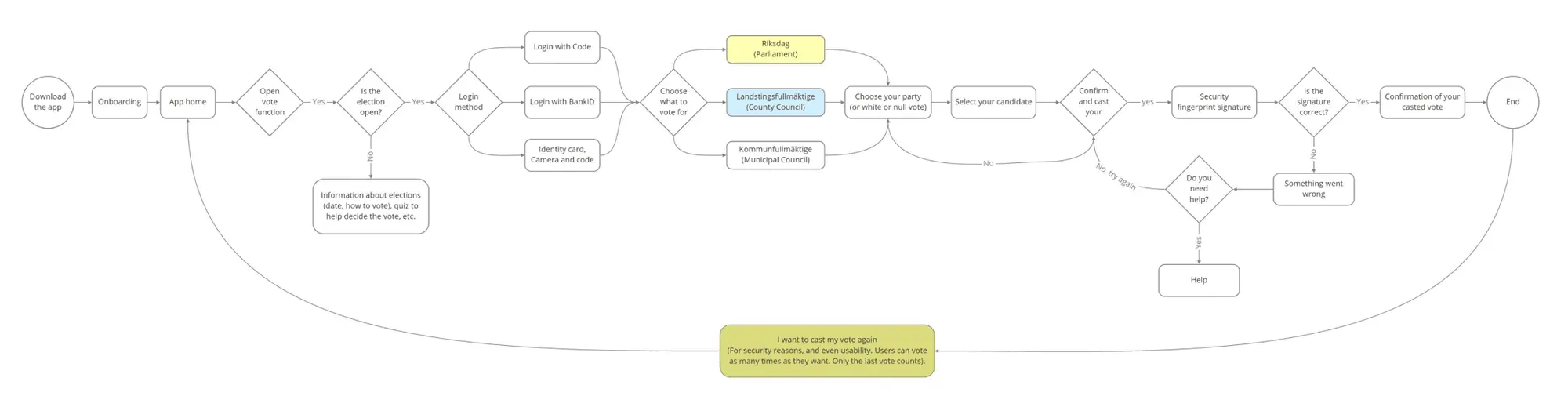
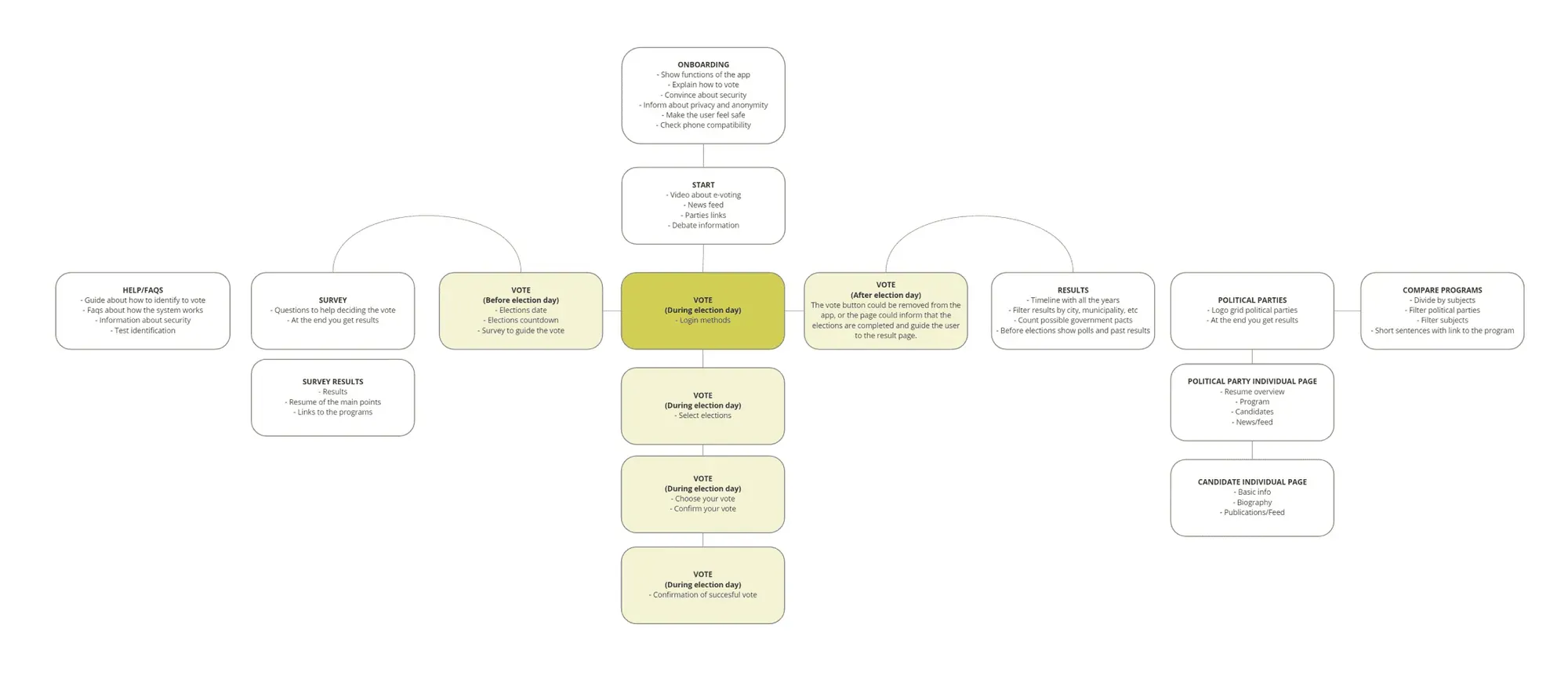
Crazy 8 sketches
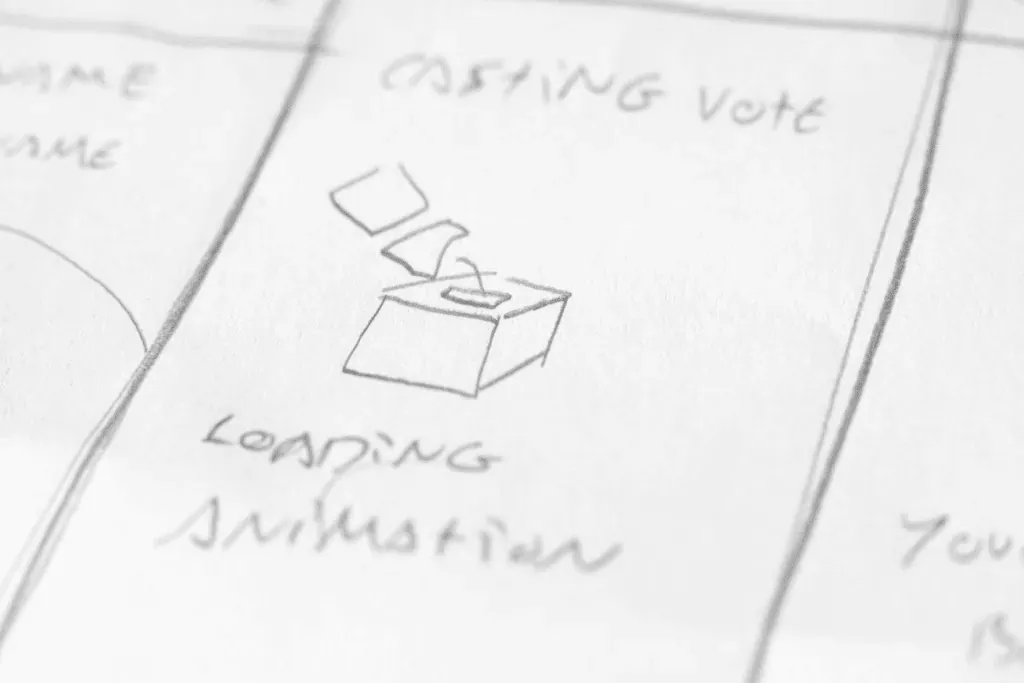
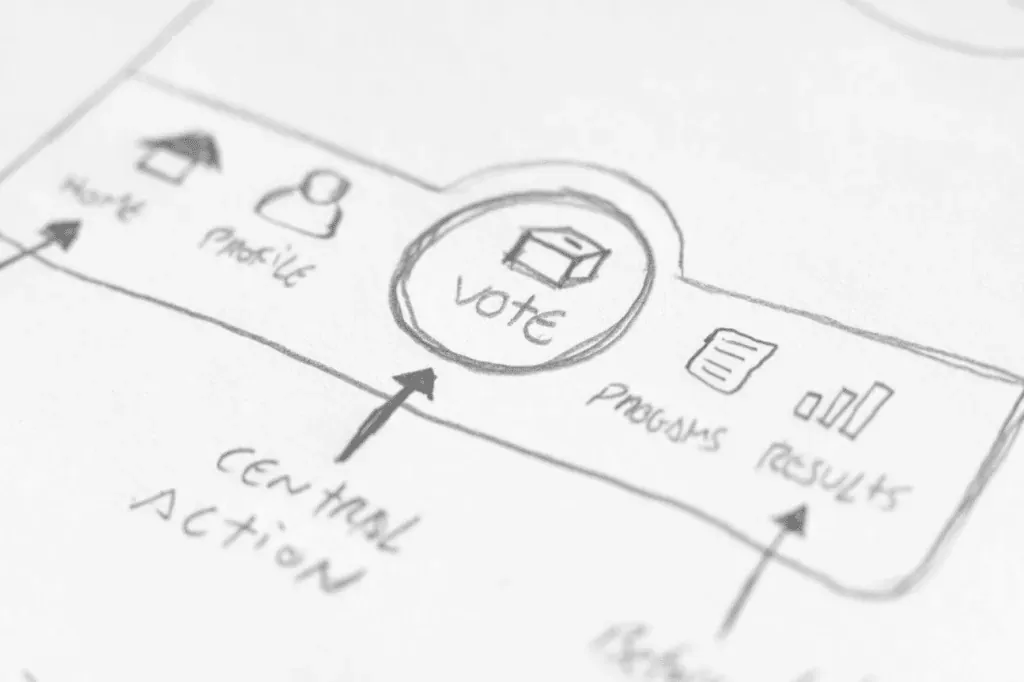
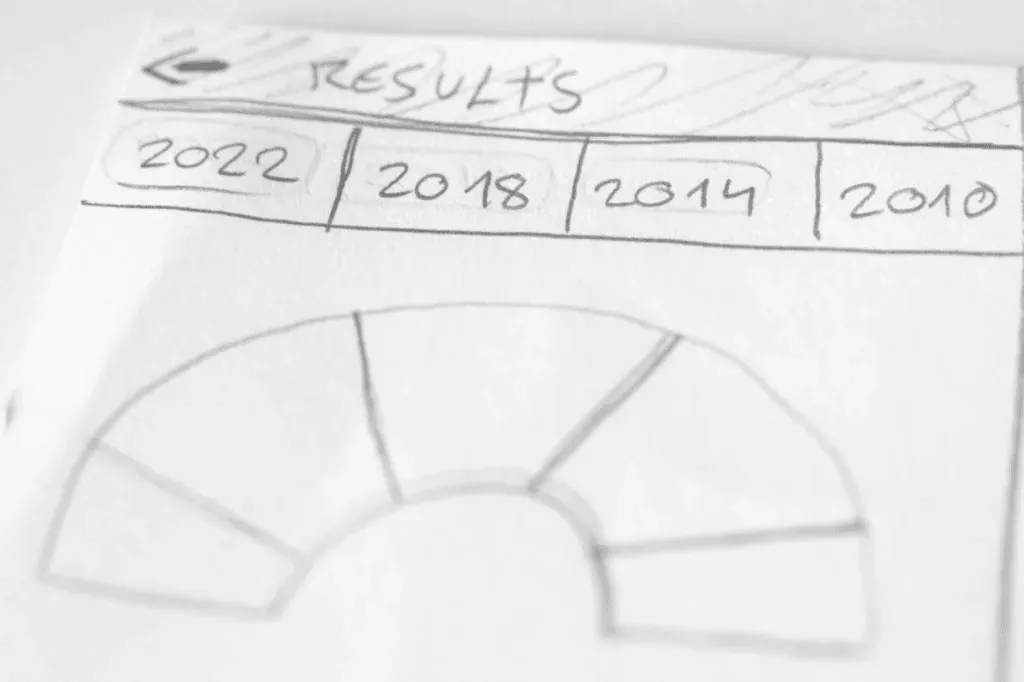
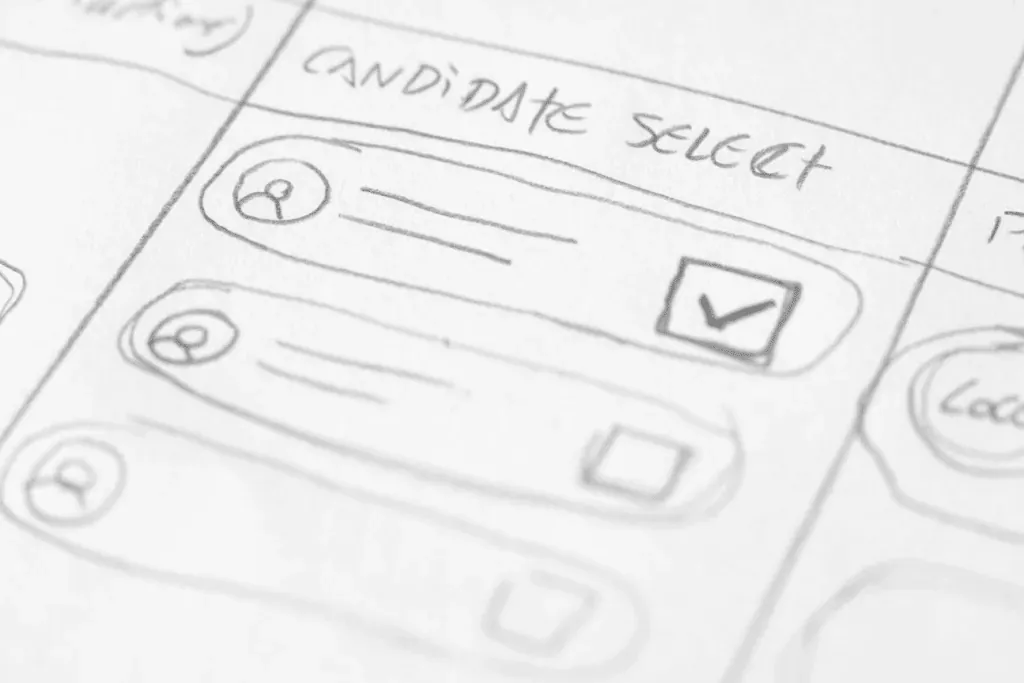
04
Prototype
Design considerations, lo-fi / hi-fi prototype
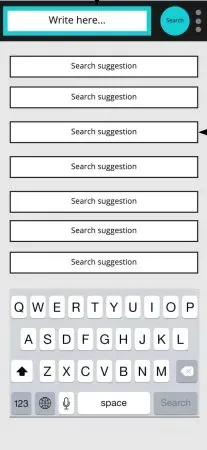
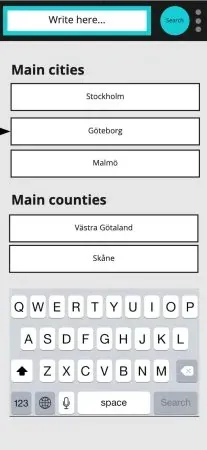
Lo-fi wireframes
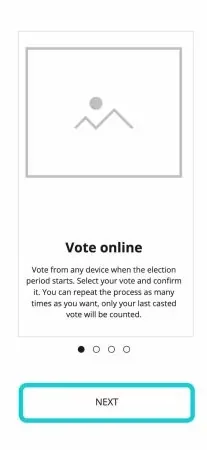
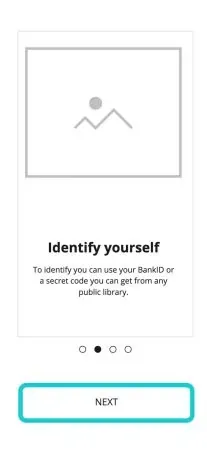
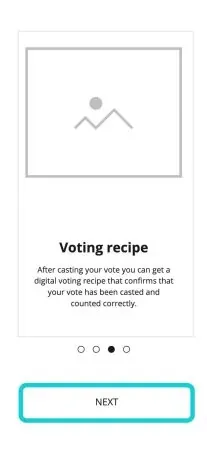
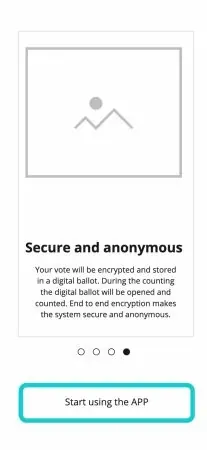
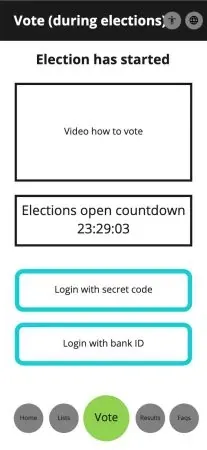
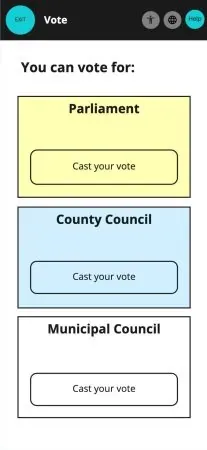
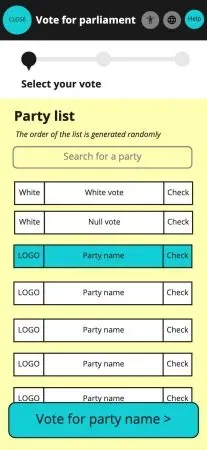
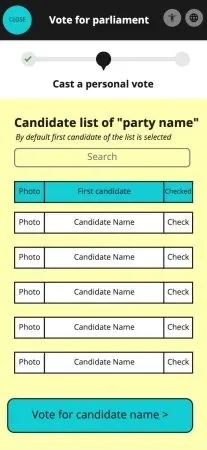
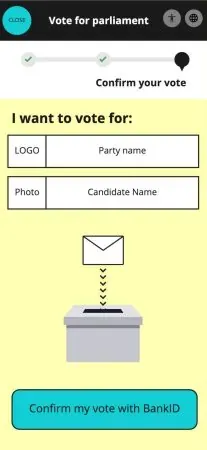
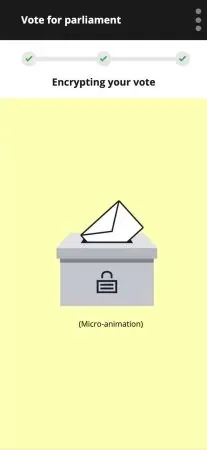
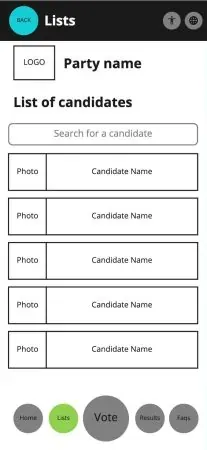
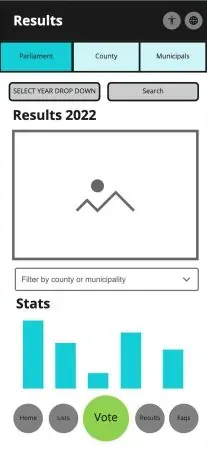
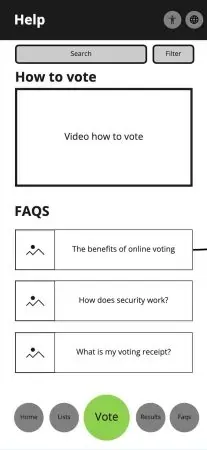
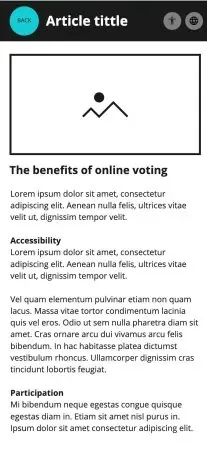
Hi-fi wireframes
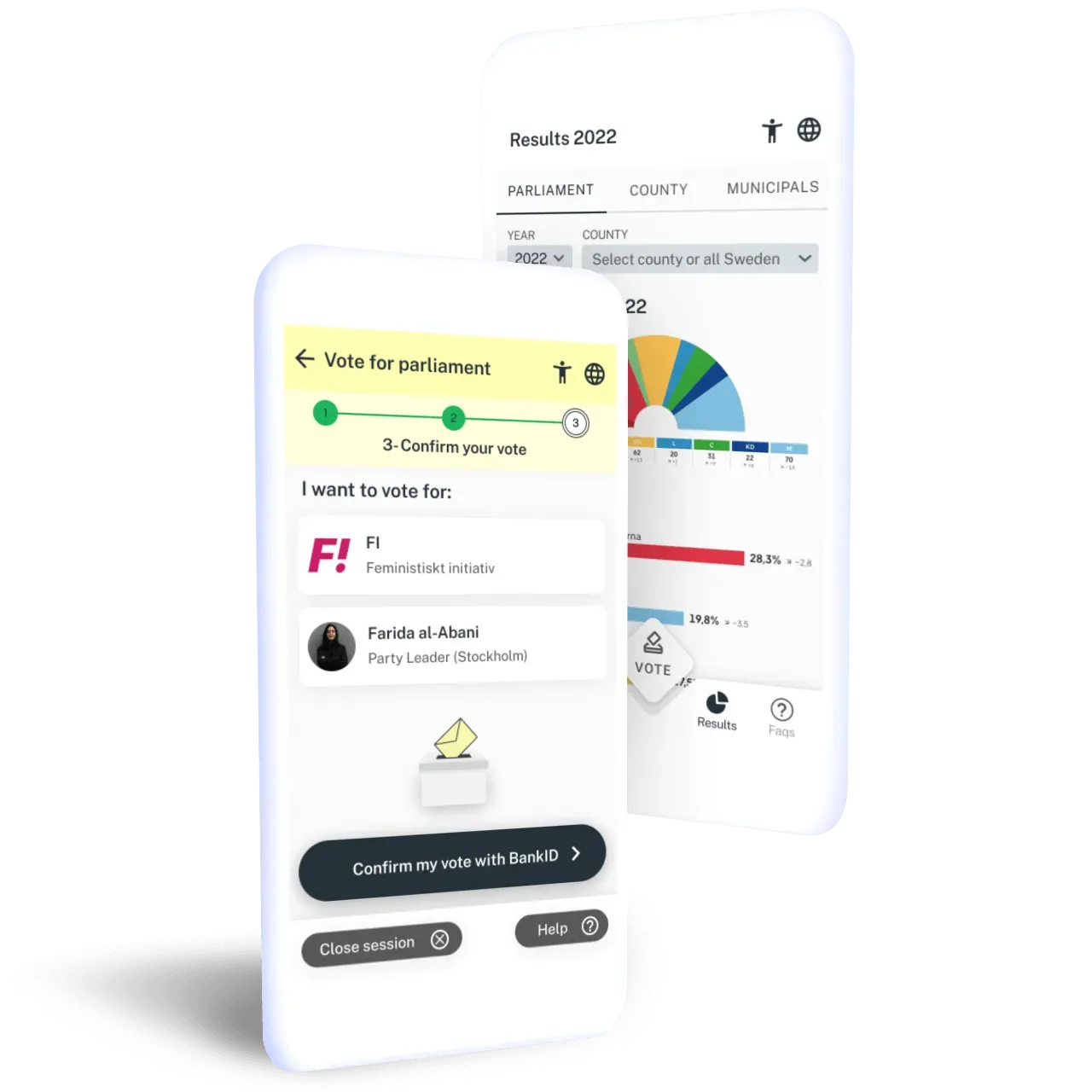
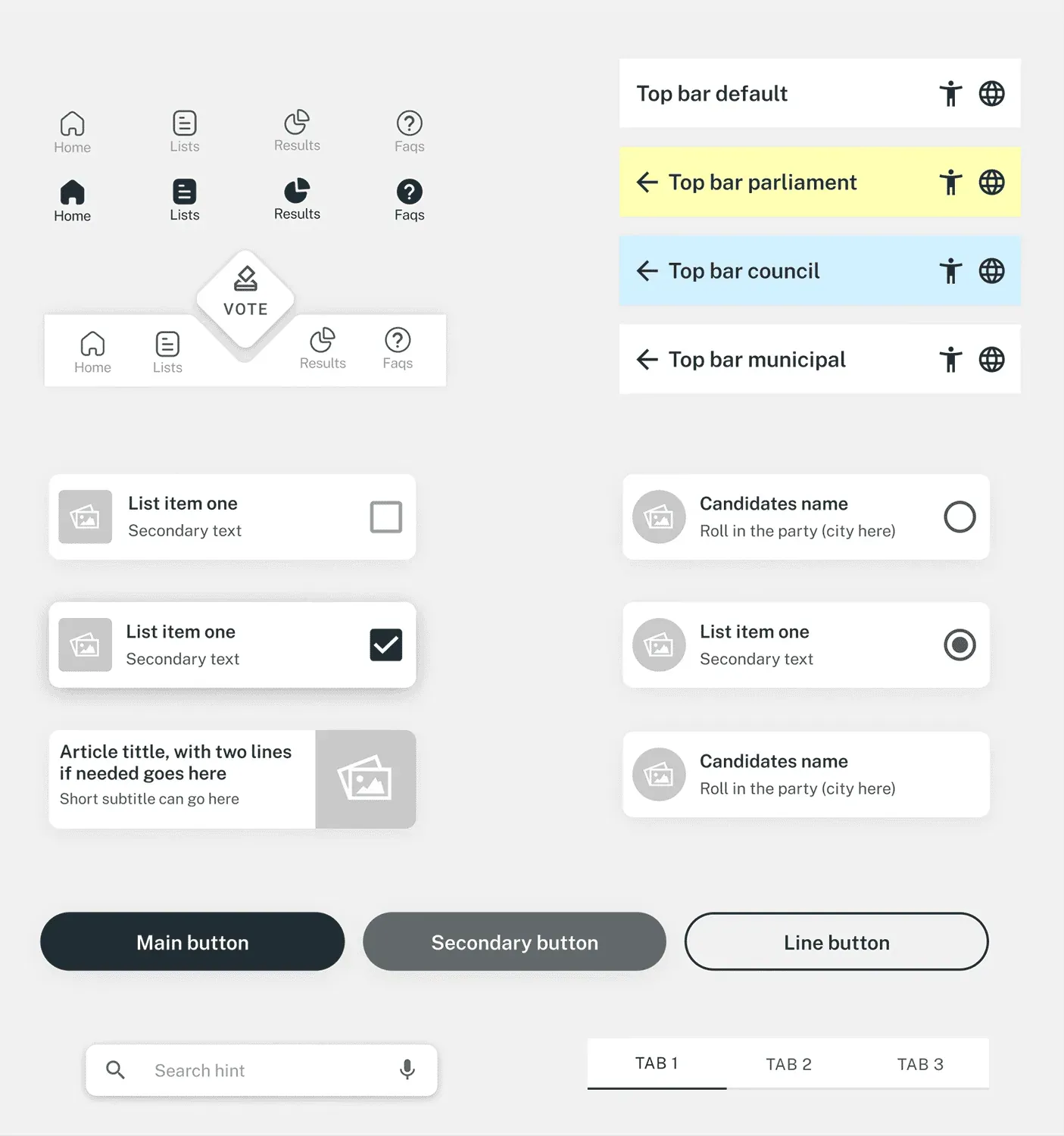
In the hi-fi prototype I focused on the style and skin of the app, I created the main components using the atomic design methodology.
The design has to be very neutral not to be confused by any political party or ideology. I followed the material design guidelines because nowadays is what most users are most used to. There’s only a small variation in the action button for voting, instead of a circle is a rhombus representing the ballot paper coming in the ballot box. Some tested users understood the visual metaphor and appreciated it.
I also developed an interactive prototype that helped me visualize how the micro animation of the cast vote could be like and to be more precise in the user tests.
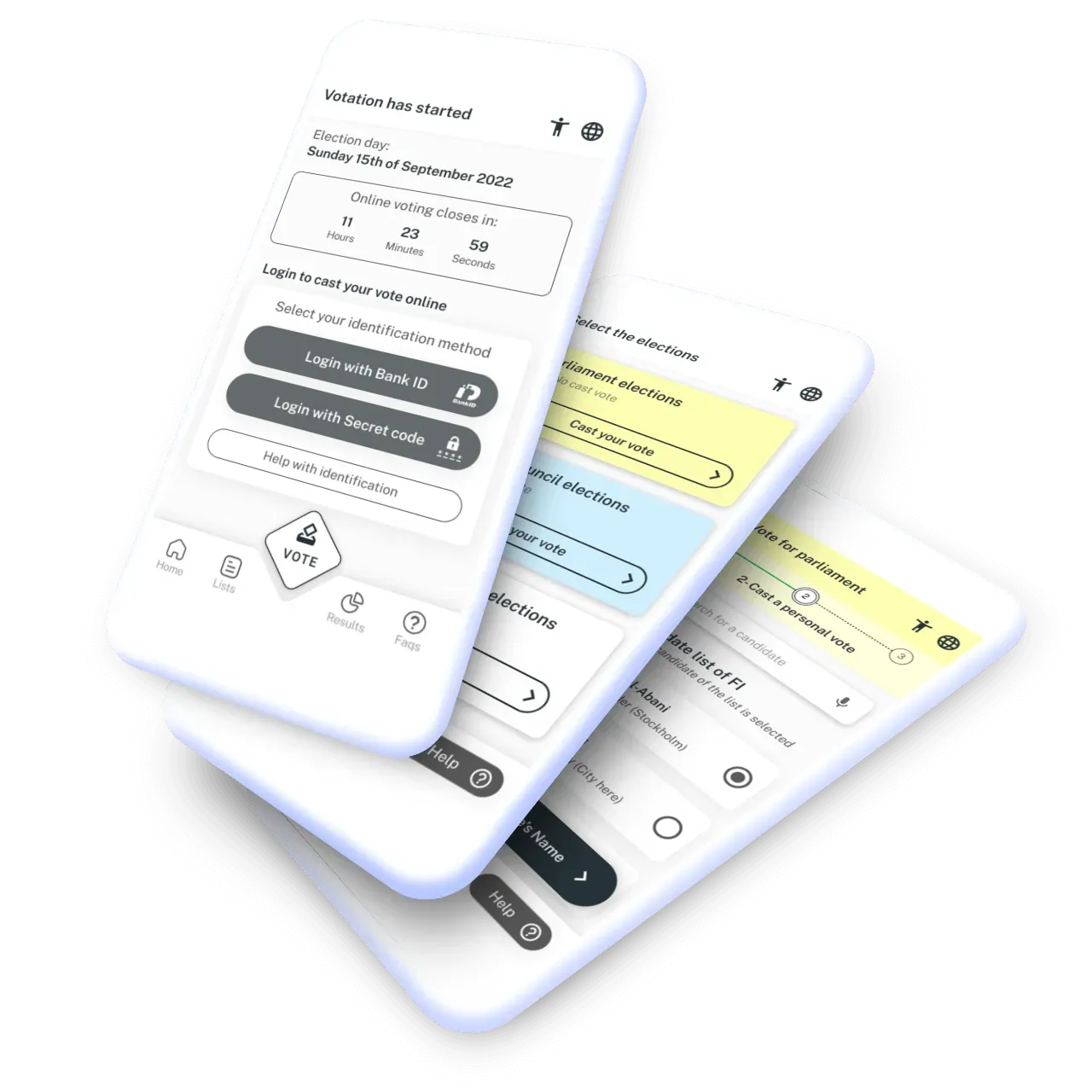
How to vote during the elections
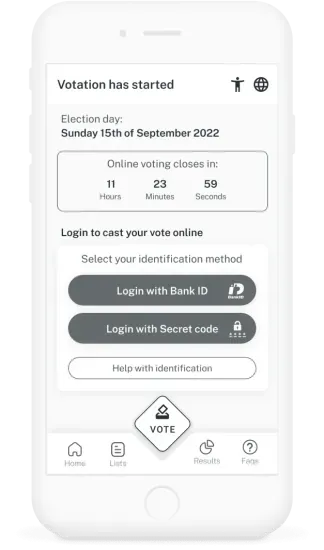
Identification method
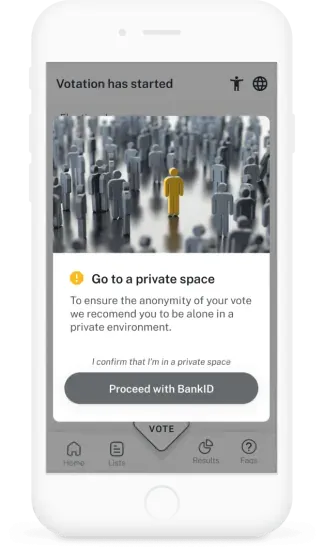
The user can identify using BankID or a Secret code they can get from the library. In this prototype only Bank ID is contemplated.
After choosing the method, there’s a popup that reminds the user to go to a private space.
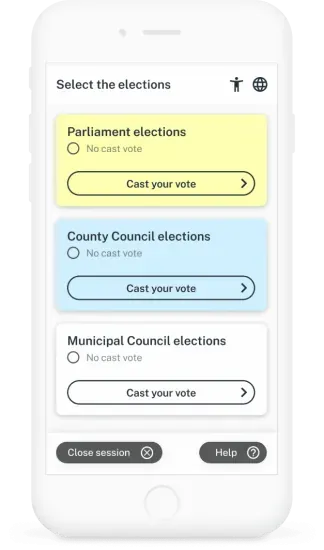
The users can choose for what elections they want to vote for. In the swedsih case, respecting the colors of the physical envelopes.
The voting process
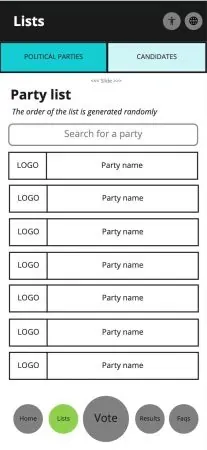
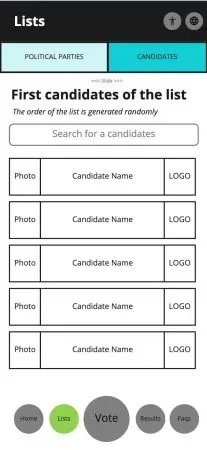
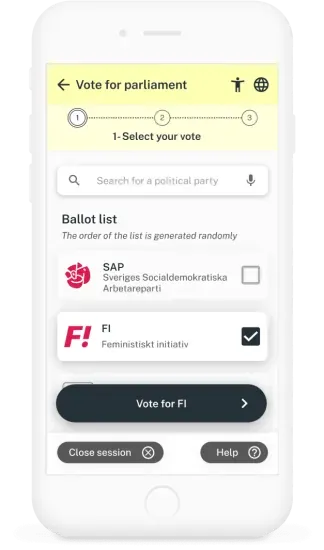
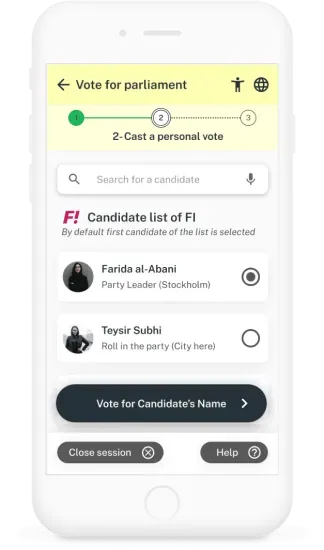
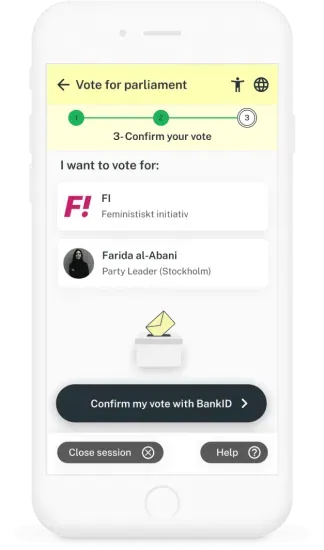
In the first step the user selects the vote, it can be a party or white and null vote. The order of the list is generated randomly to avoid favoring any kind of vote. The second step the user can select a candidate, by default the first candidate of the list is selected, like in the fisical ballot paper. The last step is to confirm the vote with Bank ID (or the secret code).
During all the process the user can close the session and get specific help for every step. Also change language and accessibility tools are available always.
Vote confirmation
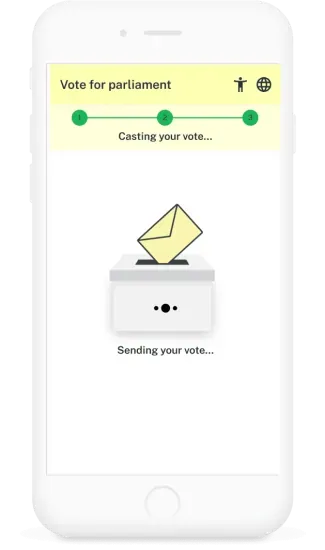
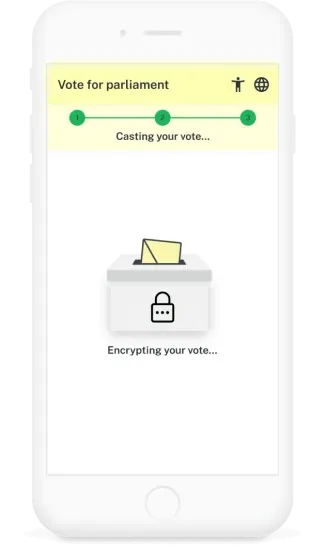
It’s important to make the user understand what’s happening with their vote. The user needs to make sure that the process went well.
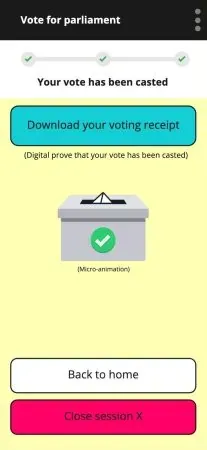
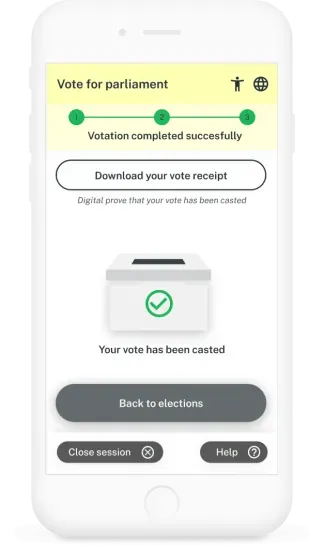
A micro animation that tells what’s happening with their vote in a very graphical way while explaining what’s happening: First sending, then encrypting and finally casted.
In the final screen the user can download the vote receipt, go back to the elections screen to vote for another election or close the session.
Before and after the elections
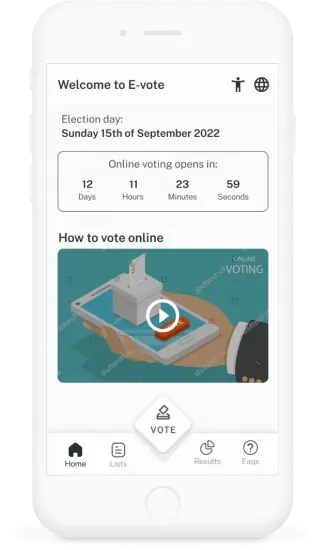
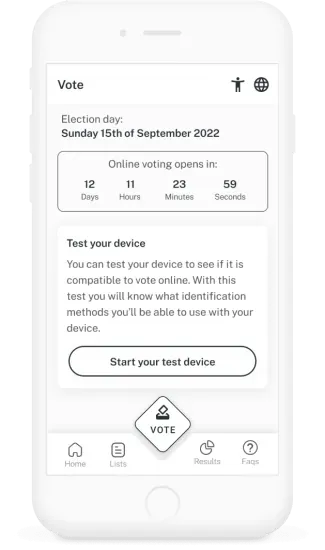
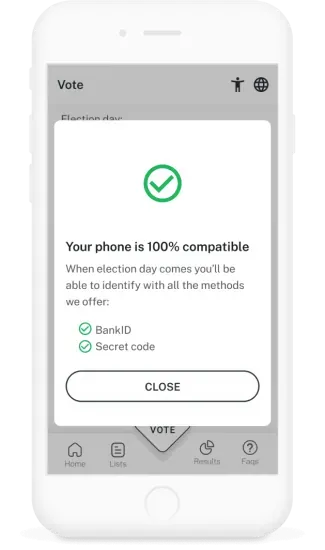
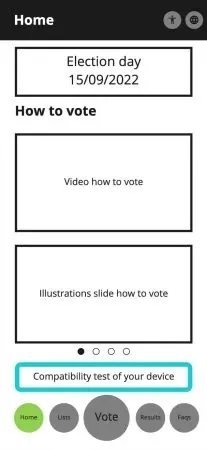
Compatibility test before elections
Before the elections the users can test their device to see what identification method they can use. This can be particularly interesting for the future implementation of biometric technologies.
The rest of the app is functional, the users can see the lists, previous results, the faqs and there’s a countdown to remind them when the election day is.
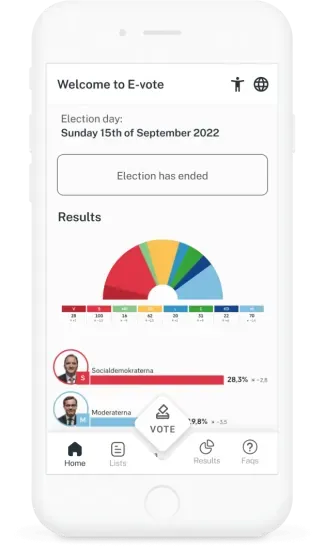
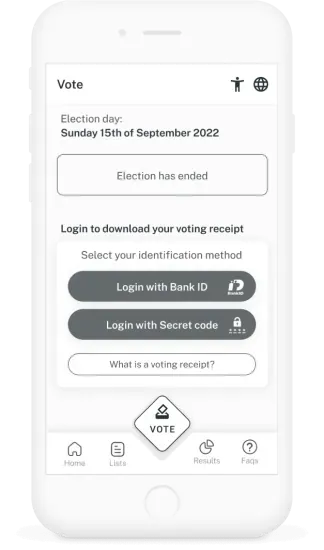
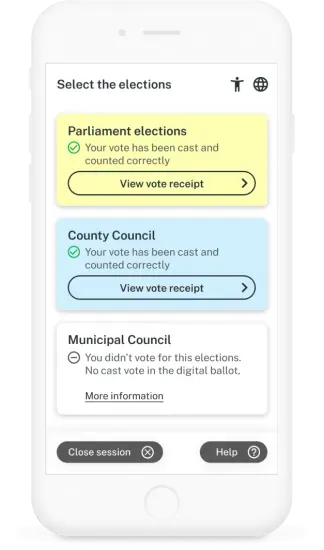
Vote receipt after elections
After the elections in the home the user can follow and see an overview of the results.
For a period of time after the counting is done, the user can get a voting receipt by identifying again. This receipt doesn’t show who the user has voted for, but tells the user that their vote has been cast and counted correctly.
Electoral lists, results and faqs
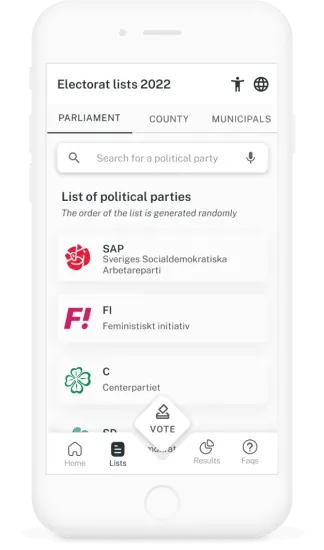
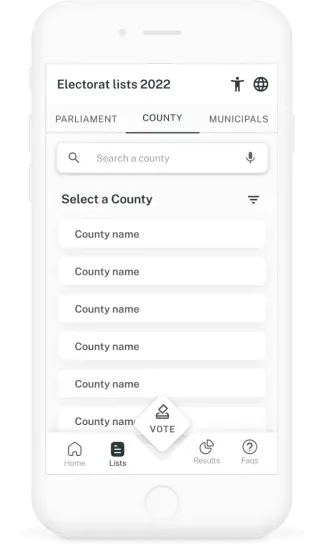
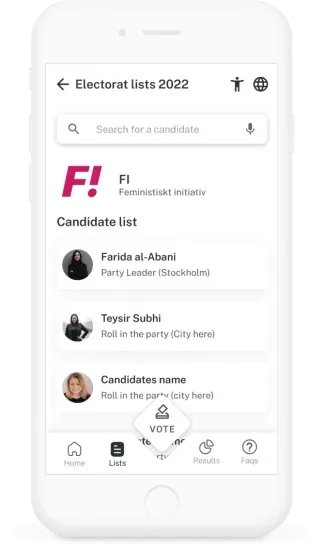
Party and candidates
The lists contain only the name of the parties and the candidates that run in the elections. So the user can check who is running before identifying to cast the vote.
It would be interesting to add more information, like the political program, candidate’s bio, and so on but it might raise security doubts, like who controls this information and it might be legally doubtful.
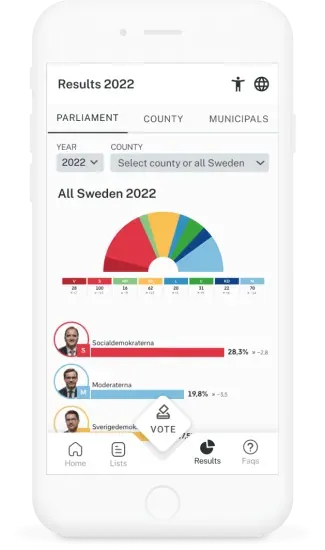
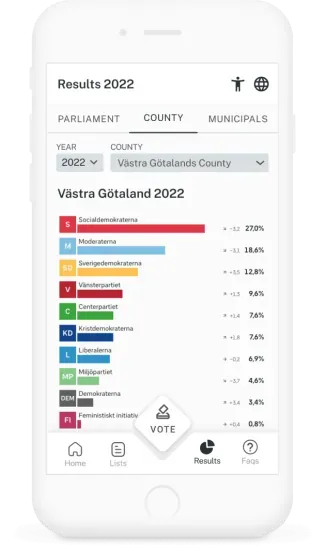
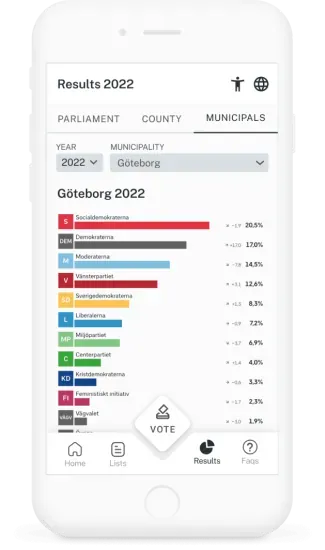
Results, before and after
Before the elections the users can see the results of previous elections. They can compare the results of different years and filter the results by county, municipality and neighborhood.
During the counting the results are transmitted in real time and the users can try what pacts can form a government.
Transparency and information
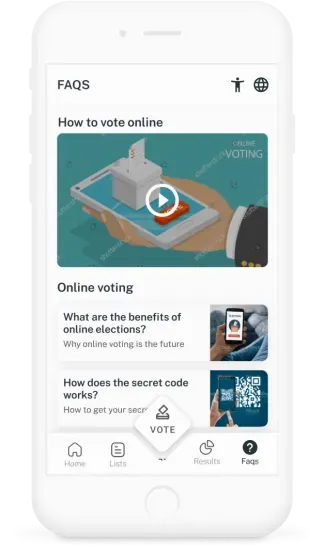
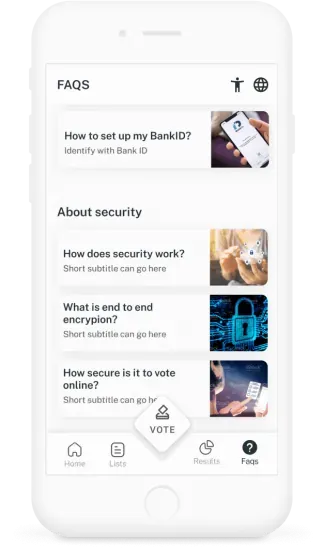
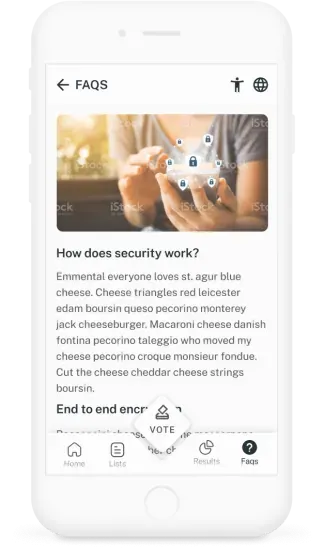
In the research some users were skeptical about online voting. It’s important to be transparent and provide information about how the system works.
In the FAQS section the user can find help about how to vote online, about how security works and any kind of information needed to gain the trust of the user.
Accessibility, language and help
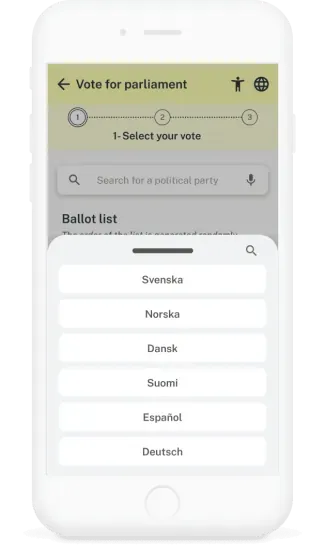
Open to everyone
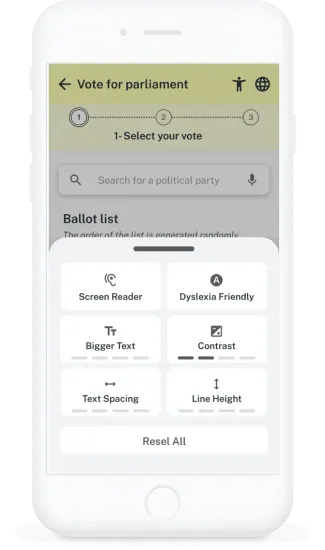
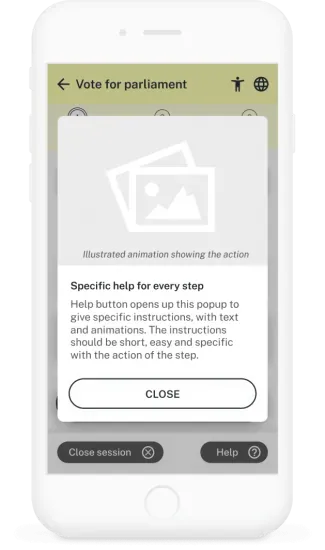
Vote is a right and has to be guaranteed to all the citizens. The app needs to be usable and accessible for a very wide range of users. That’s why the app provides an easy language switcher and an accessible toolbox to help all kinds of users.
During the voting process there’s a help button that opens a popup to give specific instructions for the process that the user needs to complete.
Design considerations
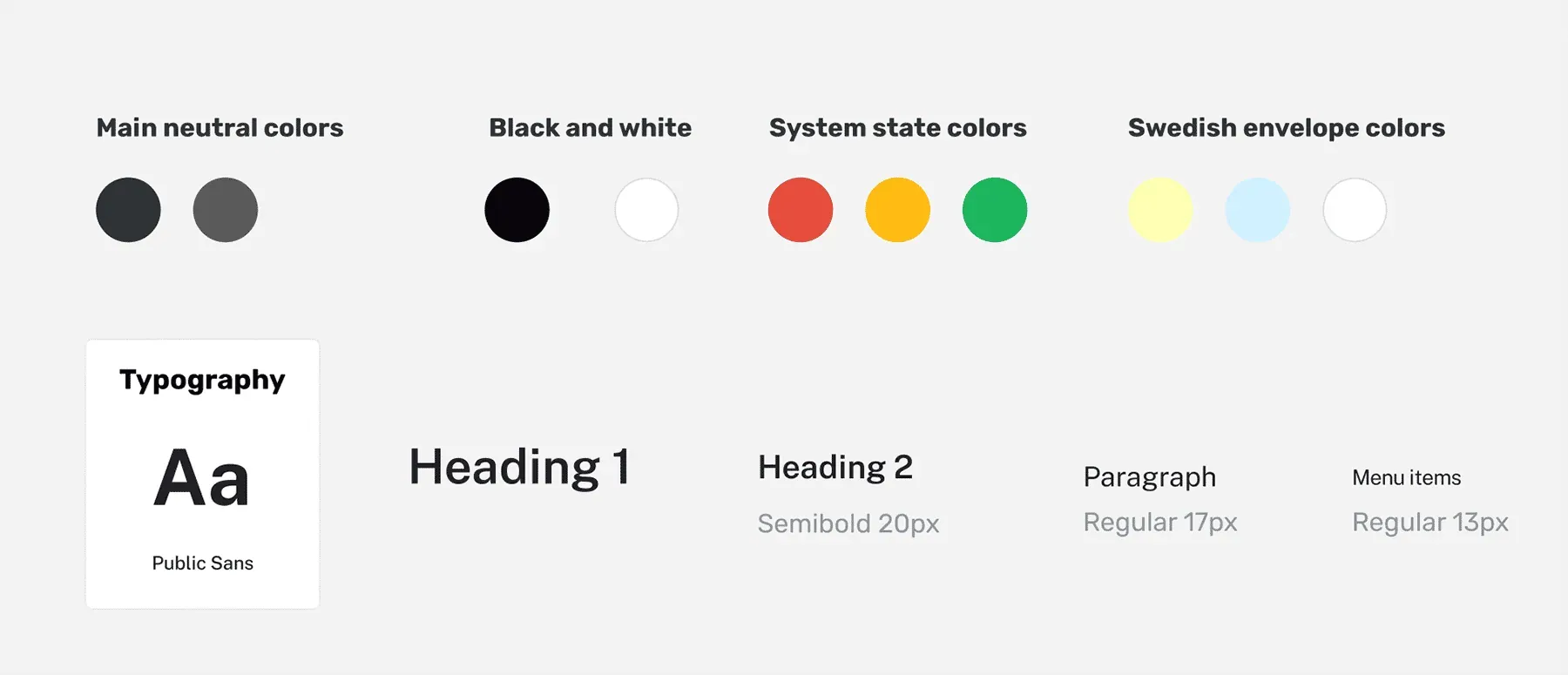
The app needs a neutral color palette, to not be confused with any political party or idiology.
The graphic manual of the Swedish government blue from the Swedish flag, but blue is also the color of the conservative parties. Using blue or any other color could interfear with the political brands profiles. Keeping it neutral with a minimal black/grey/white palette, the service can also be used in other countries.
Colors might be used in the app, for example red to indicate error or green to indicate validity, or in the Swedish case to indicate what elections, but in any case the structural palette must be neutral.

Style guide
Main components
05
Tests
User tests, A-B Tests, conclusions
User tests
During all the prototype process I conducted user tests. I tried to select a wide variety of ages, similar to the personas I created. During the tests the only differences I perceived, specially in the hi-fi prototype, is that older users read everything and younger users didn’t stop to read, they went straight to the action instead. The final result was the same, all users understood well the process and got confused in the same places.
Final conclusions
The idea of internet voting has been there since the beginning of the internet. Today we have all the tools to implement it, the only border is political will. During the research I found out that the main debate is around security, so there’s a lot of experts discussing the subject from a very technical perspective.
Security is extremely important, but if we want to convince people and politicians we have to show how online voting could be instead of throwing technical terms to people.
I think that through the UX/UI methodology online voting can only improve our democracy, because it puts the user/citizen in the center.
In the favour of design, I must say that all tested users seemed more convinced about online voting after seeing the app compared to the users I interviewed during the research stage.
Developing this project was very interesting because the challenges and problems to solve are very different from developing any other kind of commercial service.
For example, in the case of an ecommerce if a user can’t purchase a product, it’s bad for the business but not the end of it. With online voting if a user can’t vote is a vulnaration of their rights and the legitimacy of elections may be at stake.
The goal of this service is not to increase sales, it is to guarantee the right to vote and update our democracy.
In my prototype I focused on a system that could be implemented today if there were elections. That’s why at the end I discarded biometrical identification methods.
I think that in the future, when devices become more biometrical and face recognition becomes more reliable, the identification method would be easier and more secure.
UX-writing is extremely important. The copy and microcopy would need to be supervised by linguists experts in legal terms. And at the same time, it should be understandable to a very wide range of users.
During the project I started the UX-Writing from the very beginning, although my vocabulary might be imprecise hopefully the concept of the copy is there.
Work on v2 of the hi-fi prototype considering the tests
Implement the service for desktop
Deepen in accessibility tools
Work on the illustrations
Improve micro interactions
Try how the service could be in other countries
Test if the prototype is legally compliant